TAN: Where's Pierre?
We were up and ready to play the waiting game by 9 a.m. Today we were waiting on Swale, the driver that Shafiq had arranged to take us to Kilwa. He finally arrived a bit after 9:30 a.m. We got our gear loaded and made stops to get cash from an ATM and check email at the DTP office. We were on the road by 11 a.m.
The journey to Kilwa covered some 300Km south from Dar es Salaam. Swale had been told by a friend that it was only 150Km, so he was a little surprised when he finally looked at our map and figured out just how far it was. The road was in a variety of states of disrepair. There were alternating parts of pristine tarmac, smooth dirt, pothole ridden tarmac and badly rutted dirt. Getting closer to Kilwa there was a tremendous amount of Chinese led road improvement projects underway.
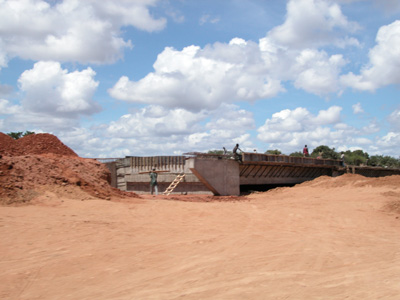
Whizzing by some Chinese sponsored road construction at 130 Km/H.
We stopped in the little hamlet of Kibiti for lunch. I don’t think many mzungu stop at the Zebra Bar and Grill. One of the wait staff came out to stare Sandrine down and gruffly mention some of the things that were available. Sandrine was at a loss with the rundown of the dishes in Swahili. We eventually got wali(rice), mchicha(spinach), and maharagwe(beans) order.
Swale’s lead foot had us all a little nervous. We took a great number of really bad stretches of road much too fast. I did not relish the though of spending the night on the roadside with a broken axle or some other such crippling breakdown. Our regular cries of “Pole, Pole”(Slow down) helped some.
We finally pulled into Kilwa Masoko around 5:00 p.m. The next hour was spent driving the length and width of the town in search of a place to spend the night. The first place we stopped at was a little dingy and didn’t have showers. The second on only had one room available. The next eight little guest houses we stopped at all claimed to be full. At this point we were getting a little exasperated and decided to try our luck at one of the two upscale places. With prices at $50-60 per person, we quickly changed our minds. We headed back to the second place to see if we could get the one room we were told about to find that they indeed had two doubles and we could have saved quite a bit of running around.
After getting settled, we headed out to find the cell tower behind the post in an effort to get a hold of Pierre, the architect for the Kilwa project. This was the only spot in town where reliable cell reception could be had. Unfortunately this was only true for Celltel customers and our Vodacom phone got nothing. We gave the payphone by the post office a try. It was a lovely model with a hand crank to generate enough a charge to let the operator know that someone wanted to make a call. The number we were calling was not in service, most likely because Pierre wasn’t standing near the tower with us. We thought to ask the guard at the post office if he knew the whereabouts of Pierre. At first he seemed not to understand, but as we were just about to leave, he suddenly figured out what we were after and pointed us off down a side street. Thus began the hunt for Pierre. At the first house down the side street we stopped and Swale asked again for directions. This got us a little further down the road and onto the next one, where upon we asked for directions again. These directions got us onto the next road with a choice of two houses. I saw what looked like a computer monitor in the first house, so figured it was a good bet.
We were in luck and the house turned out to be where Pierre was staying. He had another visitor this evening, a secondary school teacher from Dar es Salaam. We got some of the details of our visit sorted out and agreed to meet a bit later at a restaurant near where we were staying.
The restaurant turned out to be rather lackluster. It only served chips (french fries) and had no bottled water. Pierre and his guest had the foresight to eat somewhere else and showed up quite a bit after we did.We made trips out to get water and in search of something to eat. The only thing we found was rice and bananas. It was better than nothing. We were joined a bit later by two gentlemen who were starting to build a resort in the area. One of the gentlemen turned out to be the Frenchman who was one of the former owners of the Vuma Hills camp now in the possession of the Foxes. His story of the ownership change was quite different than that told by the Foxes. He also explained that three lawsuits had been filed.
We eventually headed for bed at 11:30 p.m.