TAN: Eaten Alive
Happy Birthday Mom!
We met at 7:30 a.m. for breakfast, the ladies having slept in the main building of the guesthouse and Swale and I in a bungalow outside. We each had a couple of chapattis (Indian flatbread), as the offerings of a whole dried fish or hunks of meat soaking in cloudy broth didn’t seem that appealing.
A quick trip through the marketplace got us set up with bottled water, tomatoes, bananas, mangoes, and pineapples. Our next stop was the District Commissioner’s office to get a permit to visit the islands of Songo Mnara and Kilwa Kisiwani. A gentleman claiming to be a guide glommed onto us as we got to the office. Pierre had failed to indicate that a guide would join us, so we were very standoffish. Our official handwritten document cost us a whopping $1.50 each per day. We were also given a questionnaire to fill out and return upon the completion of our visit. We headed over to Pierre’s to collect him. We found the guide, a gentleman named Saidi, there ahead of us. We apologized for not being more cordial to him at our first encounter.
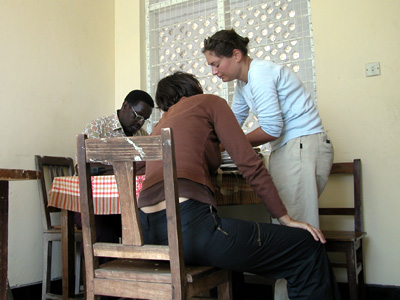
Getting our permit from the District Commissioner.
We arrived at the harbor with our ever-expanding entourage at 9 a.m. We had Chantal, Sandrine and I, along with Pierre, Swale, Saidi, the boat captain and his assistant, to pile into a 5-meter long boat. After getting everything stowed, we were off. The hour-long ride was quite pleasant as the early morning sea was out and calm. We passed Kilwa Kisiwani to find some rolling swells in an open stretch of ocean before we got in behind Songo Mnara. As soon as we got ashore at Songo the mosquitoes that were teeming in the mangroves at the shoreline set us upon. After coating ourselves with repellant, we were ready to negotiate with the local headman for permission to photograph his village and its occupants. Pierre had everything smoothed over and we were able to shoot without making any payment.
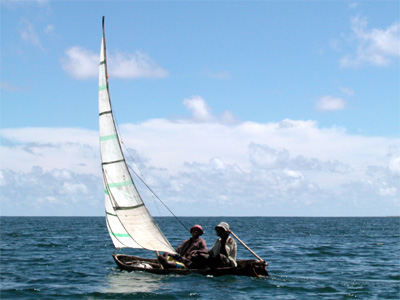
A little dhow with a sail made from plasticized sacks.
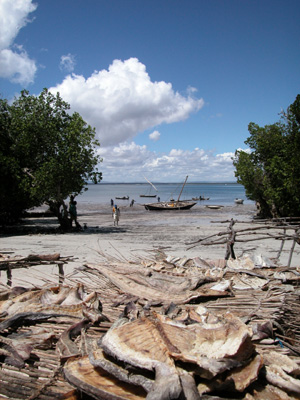
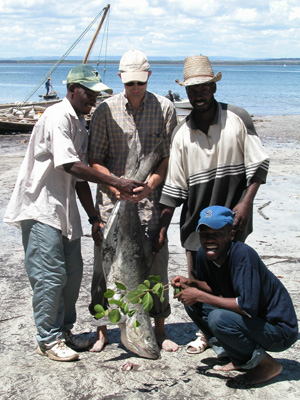
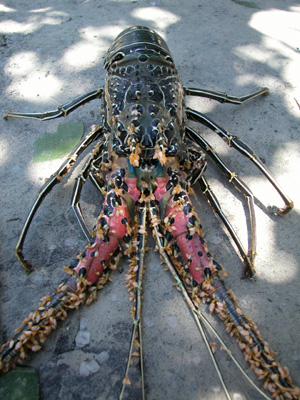
Some of the fish caught by the villagers. It is sold as far away as Dar es Salaam. Fresh catch with Saidi, Pierre, a villager and Swale in the front. A beautiful lobster with hundreds of little clams clinging to it. They will be wishing they had picked a different home.
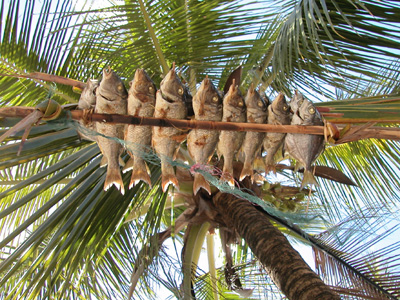
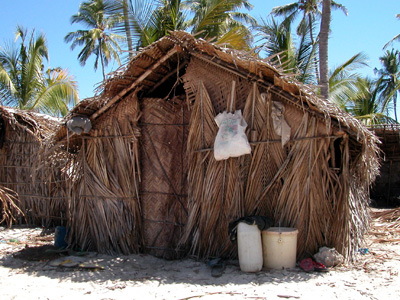
A brace of smaller fish drying on a palm tree perch. Home, sweet home.
After getting our fill of the village, we headed inland. We hadn’t gone very far before we got to a low area that was inundated with seawater. It was low tide, so it wasn’t very deep, but it was thick with mosquitoes. The ruins were just passed the wading pool. The oldest part was off to one side, jutting out of a mangrove thicket. The mosquitoes here were so dense, you could see clouds of them frantically buzzing about. They were incredibly glad to find us. We weren’t as thrilled to return the favor and moved on as quickly as possible. All of the ruins were thick with mosquitoes, buzzing about in the shadows and shade. Every place we chose to walk or stand in was a trade-off between being baked in the sun or being lunch for the ravenous mosquitoes.
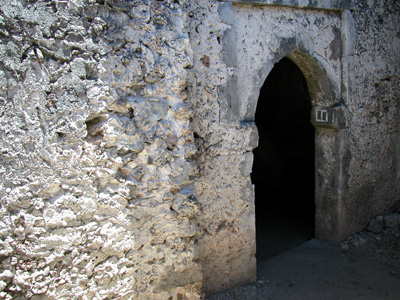
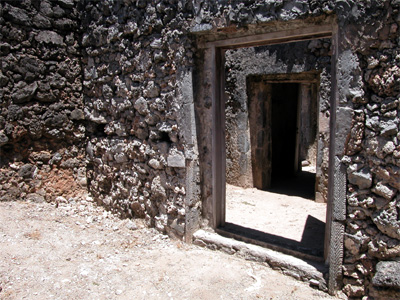
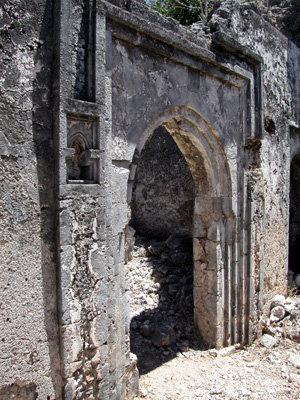
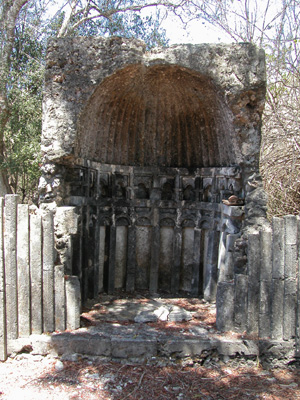
Views of the ruins on Songo.
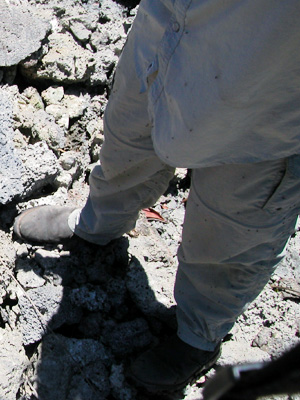
No, that is not dirt on my clothes. The mosquitoes were really, really happy to snack on us.
We were all quite happy when our tour of the ruins was finished and a lunch spot free of mosquitoes was mentioned. A short hike brought us to a stand of coconut palms. Some of the gentlemen we had seen at the village in the morning were resting in the palm grove. One of them scampered up a palm and brought down some “sodas.” The coconuts he brought down were deftly opened and we all enjoyed the refreshing milk. One of the gentleman fashioned scoops out of husks in order to get at the coconut meat. We all sat down to a delicious luncheon of the coconuts, perfectly ripe pineapple, tomatoes, and bananas.
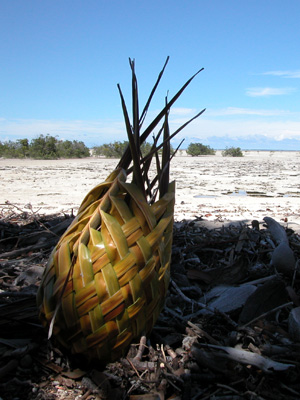
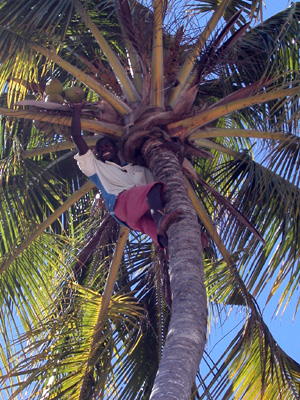
A palm frond basket. One of the villagers working hard to procure some “sodas.”
We began the hike back a bit after lunch. The tide had started to come in and the low spot we had to cross was now inundated with thigh deep water. The village looked quite different without it’s generous beachfront. Two folks from the village joined our initial group. The sea was a bit rougher, but our captain did an excellent job of keeping most of the spray away from us. At one point a school of medium-sized fish breeched alongside the boat.
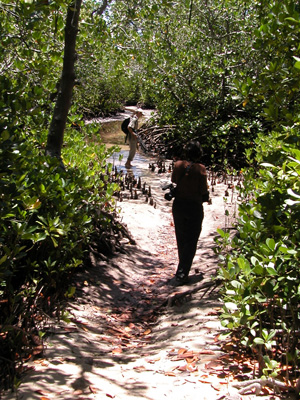
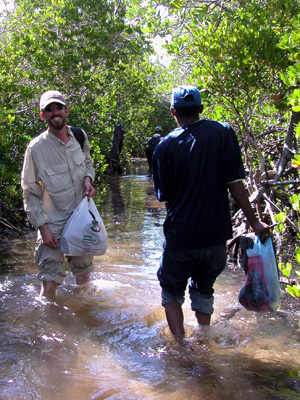
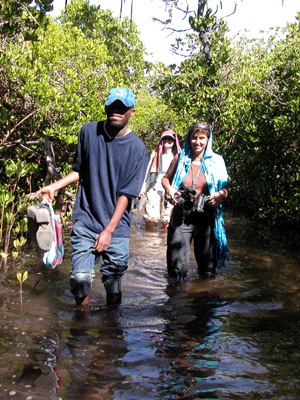
Views of the low spot, with the tide out in the morning and with the thigh high water in the afternoon. Chantal and Sandrine were a little overheated and worn out at this point.
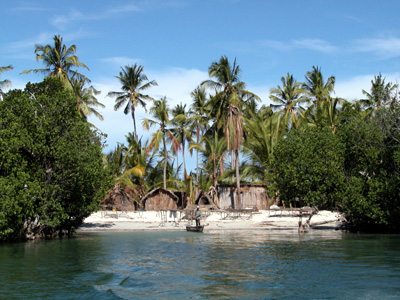
A last view of the village on Songo.
4:30 p.m. found us back at the New Mjaka Guest House. Everyone split off to their respective rooms. I relaxed and read for a bit, emerging to get some water and look for an electric outlet adapter. My room was equipped with the alternate round plug outlets. Unfortunately, my rectangular plug devices didn’t fit so well. I managed to emerge during the late afternoon prayers, so not much was open. I headed back to the room to work on the computer. Chantal and Sandrine eventually came by around 7:15 p.m. We woke up Swale and headed out on some errands. The first stop was at Pierre’s to drop off Chantal’s computer. He didn’t think we would have much luck with the rest of our errands, as there doesn’t seem to be much going on after dark. We were able to get a quantity of water, but our search for produce only yielded mangos, which we still had enough of. We dropped the car off at the guesthouse and went in search of dinner. Surprisingly a little circular thatched hut next door turned out to have what we needed. We got a plate of rice and a bowl of beans for $0.30 each. We headed for bed right after dinner in anticipation of a 4:15 a.m. wake up.
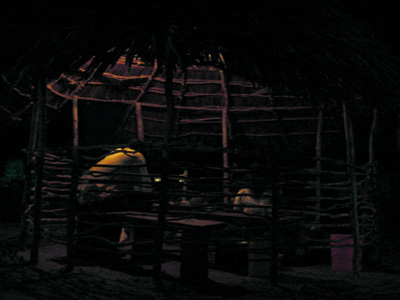
The diner where we had a dinner of rice and beans.